
What Does RERA Registration Mean for Buyers?
RERA registration means a real estate project has been registered with the state’s Real Estate Regulatory Authority under the Real Estate (Regulation and Development) Act, 2016, and the promoter has legally disclosed key project details, land title, approvals, timelines, and layout plans to a public regulator before selling any unit. For a buyer, this translates into access to verified information and specific legal remedies that were largely unavailable before 2016. It does not, however, mean the project is risk-free.
What Is RERA Registration?
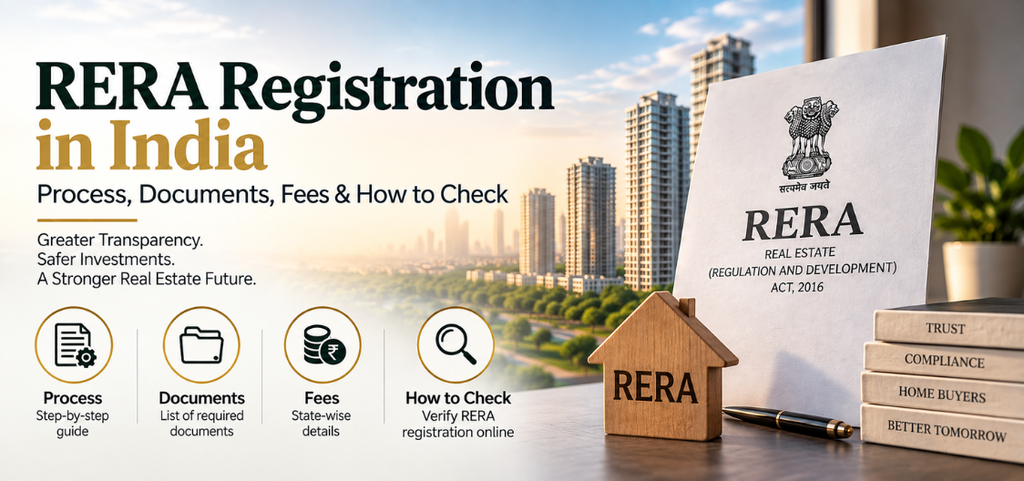
RERA stands for the Real Estate (Regulation and Development) Act, 2016, a central law implemented through state and UT-level Real Estate Regulatory Authorities. It received presidential assent on 25 March 2016 to establish regulatory authorities for the real estate sector and protect homebuyers from practices such as project delays and fund misuse.
Project registration is the process by which a promoter files project details, land records, approved plans, timelines, and promoter history with the relevant state RERA before advertising or accepting bookings. Projects with land exceeding 500 square meters or more than eight apartments generally require RERA, covering residential, commercial, and plotted developments. When a listing says “RERA registered,” it means that filing exists and is publicly checkable, not that the authority has certified the project’s quality.
What Does RERA Registration Mean for Buyers?
For RERA registration for buyers, the practical value lies in transparency: promoters must disclose the sanctioned plan, promoter track record, and project timeline on the state RERA portal and update construction progress periodically. The Act also requires developers to deposit at least 70% of buyer funds into a project-specific escrow account, restricting fund diversion to other projects. Buyers also gain access to a defined complaint mechanism before the RERA authority instead of relying solely on civil courts.
What Does RERA-Registered Property Mean?
RERA-registered property, meaning, in simple terms, is a unit within a project that has an active registration number and is sold strictly on carpet-area terms rather than ambiguous “super built-up area” pricing. Buyers can verify the registration number, promoter name, and project status on the portal. What it does not mean is that the builder is guaranteed reliable, the location is ideal, or every disclosure is error-free; buyers still need to cross-check details independently.
Benefits of RERA Registration for Buyers
The benefits of RERA registration for buyers include:
- Mandatory sale based on carpet area, not vague built-up measurements
- Escrow-based fund usage, reducing diversion of buyer money to unrelated projects
- Structural defect liability: builders remain liable for structural defects for five years from possession or the completion certificate, whichever is earlier
- Penalties for delay, including interest or refund options where the promoter defaults
- A time-bound grievance forum instead of prolonged civil litigation
These are meaningful protections, but they operate within the law’s scope; they don’t extend to matters like resale value or neighborhood development.
What Should Buyers Check Before Buying?
- RERA registration number and its validity period
- Promoter name and past project history on the portal
- Declared possession date and any revisions
- Carpet area as stated in the agreement versus the floor plan
- Approved layout and any deviations
- Litigation or complaint history against the promoter
- Payment schedule, cancellation, and refund clauses in the agreement
- Title documents and other statutory approvals, independent of RERA
How Can Buyers Verify RERA Registration?
- Identify the state or UT RERA authority for the project’s location.
- Visit that authority’s official portal.
- Search by project name, promoter name, or registration number.
- Review the disclosed plans, timeline, and promoter details.
- Compare this against what the sales team or brochure claims.
- Check for any complaints or orders listed against the promoter.
- Consult a property lawyer for anything unclear before signing.
Does RERA Registration Guarantee a Safe Purchase?
No. RERA registration provides regulatory transparency and specific legal remedies, but it does not eliminate every risk in a property transaction. Buyers should still independently verify title and ownership, statutory approvals beyond RERA, construction quality, the developer’s financial standing, and the terms of the builder-buyer agreement.
RERA Registration vs Broader Due Diligence
| RERA Registration | Broader Property Due Diligence |
| Project-level regulatory filing | Legal and commercial verification |
| Disclosed plans and timelines | Title and ownership checks |
| Escrow and fund-use rules | Loan, tax, and financial review |
| Complaint mechanism under RERA | Contract-specific legal review |
| Project-level transparency | Site, quality, and location assessment |
RERA registration is one input into due diligence, not a substitute for it.
Common Mistakes Buyers Make
- Assuming registration means zero risk
- Not checking the registration number’s validity directly on the portal
- Relying only on the builder’s brochure or website
- Skipping the promoter’s litigation history
- Ignoring the agreement’s fine print on delay and cancellation
Conclusion
RERA registration gives buyers something the pre-2016 market rarely offered: a public, verifiable record of a project’s plans, timelines, and promoter obligations, backed by a formal complaint mechanism. That’s real protection, not a formality. But it works alongside due diligence, not instead of it; title verification, contract review, and independent checks on the developer still rest with the buyer. Treat RERA registration as the starting point for informed decision-making, not the final word on whether a property is worth buying.
Frequently Asked Questions
1. What is RERA registration?
Ans: It’s the mandatory filing of a real estate project with the state RERA authority before it can be advertised or sold, disclosing land title, plans, and timelines.
2. Is an RERA-registered property safe to buy?
Ans: It’s safer in terms of transparency and legal remedies, but buyers must still complete independent due diligence.
3. Does RERA registration guarantee possession on time?
Ans: No, but it entitles buyers to compensation or refund remedies if the promoter defaults on the declared timeline.
4. Does RERA registration guarantee construction quality?
Ans: Not directly, though promoters carry a five-year structural defect liability from possession or completion, whichever is earlier.
5. What rights do buyers have under RERA?
Ans: Rights include access to project information, remedies for delay, structural defect liability, and a formal complaint process before the RERA authority.
Also Read: First-Time Homebuyer in Gurugram? Here’s Your Simple Checklist